Chapman State Park

Charles County, MD

Undeveloped state park on the tidal Potomac main stem below Indian Head, with a long natural shoreline. Tidal Potomac fishing for striped bass, white perch, blue catfish, and largemouth bass, plus the river's notorious northern snakehead in the shallow grass.

Live · updated

Blue Catfish, Largemouth Bass, Channel Catfish & Northern Snakehead — tied at the top (86/100)

4 species tied for best of 6 tracked at Chapman State Park.

86 /100
ideal
Air Temp
87°F
Mostly Sunny
Wind
2 to 10 mph
W
Rain
2%
Saturday
Pressure
Steady
6-hour trend
Water Temp
73°F
Tidal waters
Tide
incoming
Seas
0.7 ft
Nearest buoy wave height
Sunrise
5:44 AM
Sunset
8:29 PM
Moon · 70%
waning gibbous
Time Type Height
4:57 AM Low 0.6 ft
11:42 AM High 2.1 ft
5:36 PM Low 0.4 ft

6 species tracked, ranked by today's conditions. The top 4 (tied) are open below — tap any species to expand it, or a chip to focus.

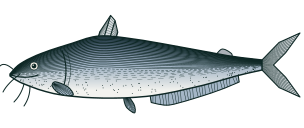
#1 Blue Catfish Drop everything — ideal day for Blue Catfish. In season 86/100

What's helping

  • 73°F water — right in blue catfish's ideal range
  • 10 mph wind — light chop — baitfish active, fish willing to feed

About. Ictalurus furcatus — Invasive apex predator, now abundant throughout the tidal Potomac, Patuxent, and Nanticoke. MDDNR actively encourages harvest. Caught on cut bait (bunker, white perch, gizzard shad) fished on bottom. 50+ lb fish are routine on the Potomac.

Prefers. Water 55–85°F (ideal 72°F) · either tide · depth 10–60 ft.

Regulations may be out of date

Last verified 44 days ago on 2026-04-22. Open source page →

Daily creel
no limit

Potomac River main stem (PRFC): invasive, no size limit, no daily creel limit, open year-round. PRFC, MDDNR, and VDWR all encourage harvest on the Potomac. The tidal Potomac produces 50+ lb fish routinely; it's a destination trophy fishery.

Source: Potomac River Fisheries Commission regulations · verified 2026-04-22.

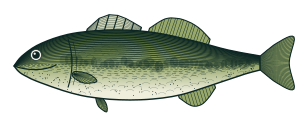
#1 Largemouth Bass Drop everything — ideal day for Largemouth Bass. In season 86/100

What's helping

  • 73°F water — right in largemouth bass's ideal range
  • 10 mph wind — light chop — baitfish active, fish willing to feed

About. Micropterus salmoides — Most popular gamefish in MD non-tidal waters. Ambush predator around cover — lily pads, submerged timber, docks, grass edges. Hits plastics, spinnerbaits, jigs, and topwater across the season.

Prefers. Water 55–85°F (ideal 72°F) · either tide · depth 3–25 ft.

Regulations may be out of date

Last verified 44 days ago on 2026-04-22. Open source page →

Min size
12"
Daily creel
5

Potomac River main stem (PRFC): 12-inch minimum most of the year, stepping UP to 15-inch minimum March 1–June 15 to protect the spawn. 5 per day. Circle hooks not required. The tidal Potomac is a legendary bass fishery (Fletchers Cove up to Great Falls, Mattawoman, Pomonkey). Distinct from MD non-tidal rules (which have a full March–June 15 C&R closure).

Source: Potomac River Fisheries Commission regulations · verified 2026-04-22.

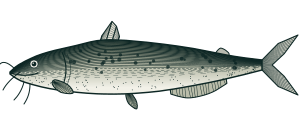
#1 Channel Catfish Drop everything — ideal day for Channel Catfish. In season 86/100

What's helping

  • 73°F water — right in channel catfish's ideal range
  • 10 mph wind — light chop — baitfish active, fish willing to feed

About. Ictalurus punctatus — Native catfish of MD non-tidal rivers, reservoirs, and farm ponds. Bottom-feeder that takes chicken liver, stinkbait, nightcrawlers, and cut bait. Most active at night and in warm water.

Prefers. Water 60–85°F (ideal 75°F) · either tide · depth 5–30 ft.

Regulations may be out of date

Last verified 44 days ago on 2026-04-22. Open source page →

Daily creel
10

Potomac River main stem (PRFC): 10 per day, no minimum size. Less restrictive than NTVA (20/day) and NTMD (5/day) — PRFC sits in the middle. The tidal Potomac also has a thriving channel cat fishery below the Wilson Bridge.

Source: Potomac River Fisheries Commission regulations · verified 2026-04-22.

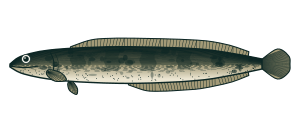
#1 Northern Snakehead Drop everything — ideal day for Northern Snakehead. In season 86/100

What's helping

  • 73°F water — right in northern snakehead's ideal range
  • 10 mph wind — light chop — baitfish active, fish willing to feed

About. Channa argus — Invasive ambush predator, now established throughout the tidal Potomac and much of the Eastern Shore. Also marketed as "Chesapeake Channa" to encourage harvest. Explosive topwater strikes in lily pads and grass flats; hits frogs, Chatterbaits, and swimbaits.

Prefers. Water 55–85°F (ideal 75°F) · either tide · depth 2–10 ft.

Regulations may be out of date

Last verified 44 days ago on 2026-04-22. Open source page →

Daily creel
no limit

Potomac River main stem (PRFC): invasive, no size limit, no daily creel, open year-round. It is illegal to possess a live snakehead or to release any living snakehead — anglers must kill the fish immediately. The tidal Potomac is the epicenter of the mid-Atlantic snakehead fishery; Mattawoman, Pomonkey, and the Anacostia are the best-known hotspots.

Source: Potomac River Fisheries Commission regulations · verified 2026-04-22.

#5 White Perch Workable day for White Perch. In season 68/100

What's helping

  • 73°F water — inside white perch's active range
  • 10 mph wind — light chop — baitfish active, fish willing to feed

What's hurting

  • incoming tide — white perch prefers outgoing tide

About. Morone americana — Smaller cousin of the striped bass and arguably the Bay's most popular panfish. Schools heavily in tidal rivers and creeks; hits bottom rigs with bloodworms, grass shrimp, or small jigs. Spring spawning run into the freshwater ends of tributaries is the marquee fishery.

Prefers. Water 50–78°F (ideal 65°F) · outgoing tide · depth 3–25 ft.

Regulations may be out of date

Last verified 44 days ago on 2026-04-22. Open source page →

Min size
8"
Daily creel
10

Potomac River main stem (PRFC): 8-inch minimum, 10 per day for recreational hook-and-line. More restrictive than either MD or VA tidal rules — PRFC caps the creel where neither state does. Spring tributary runs (Pomonkey, Mattawoman, Nanjemoy) are the marquee fishery.

Source: Potomac River Fisheries Commission regulations · verified 2026-04-22.

#6 Striped Bass Marginal conditions for Striped Bass. In season 48/100

What's helping

  • incoming tide — striped bass prefers incoming tide
  • 10 mph wind — light chop — baitfish active, fish willing to feed

What's hurting

  • 73°F water — above striped bass's active range (50–72°f) — fish move deep

About. Morone saxatilis — Maryland's state fish. Anadromous — runs into Bay tributaries to spawn each spring. Targeted by trolling, jigging, live-lining, and surf casting. Locally called "rockfish."

Prefers. Water 50–72°F (ideal 62°F) · incoming tide · depth 5–35 ft.

Regulations may be out of date

Last verified 44 days ago on 2026-04-22. Open source page →

Min size
19"
Max size
24"
Daily creel
1

Potomac River main stem, managed by the Potomac River Fisheries Commission. 19–24 inch slot, 1 fish per day. Open May 16–July 6 and August 21–December 31 (summer C&R closure July 7–August 20 to protect fish from thermal stress, mirrors VA's Potomac tributaries rule in 4VAC20-252-100). January 1–May 15 is catch-and-release only. Non-offset circle hooks required when fishing with cut or whole natural bait. Live eels are prohibited year-round. The PRFC regulation applies to the main stem only — tributaries follow MD or VA state regs depending on bank.

Source: Potomac River Fisheries Commission regulations · verified 2026-04-22.

Water Body

Potomac River

Access

Shoreline access

Jurisdiction

Potomac River Fisheries Commission

Coordinates

38.6151, -77.1160

Notes

Tidal Potomac main stem — PRFC regulations apply regardless of which shore you fish from. Largely undeveloped, with limited facilities.

What anglers are reporting

From the Maryland DNR weekly fishing report, published May 27, 2026.

Lower Bay

Deeper waters along channel edges are being targeted by anglers jigging with soft plastic jigs or by trolling with umbrella rigs down along the 30-foot edges. It is a good idea to place a few Drone spoons behind inline weights for the bluefish that are in the region. The steep channel edge of the Potomac from St. Georges Island to Piney Point, the lower Patuxent and the eastern side of the bay from Buoy 76 to Buoy 72 are worth exploring. Red and black drum are being found on the eastern side of the Bay from the Middle Grounds up past the Target Ship and Tangier Sound. Finding them on depth finders and dropping soft crab baits to them is the most popular way to fish.

Species mentioned: black drum, bluefish

Excerpts are anecdotal and reflect a single week's observations from DNR biologists and reporting anglers — not predictions. Use as one signal among many; verify against current conditions before planning a trip.

Local reports & rules for Chapman State Park: Maryland DNR fishing report → · trout stocking schedule → · fish-consumption advisory →

Do I need a fishing license to fish at Chapman State Park?

Yes (anglers age 16 and older). To fish at Chapman State Park you need a Potomac River Fisheries Commission (PRFC) Sport Fishing License — separately issued from MD or VA tidal licenses, with reciprocity for some classes of MD/VA license holders. See the agency's current rules: https://prfc.us/sports.html

What fish are commonly targeted at Chapman State Park?

Chapman State Park is listed on this site for 6 commonly-targeted species: Striped Bass, White Perch, Blue Catfish, Largemouth Bass, and 2 more. Which species is currently in season and which is scoring highest today is shown in the per-species ranking on this page.

When is the best time to fish at Chapman State Park?

It depends more on the species and the day's conditions than on a fixed "best hour." Water temperature, weather, and — at tidal locations — the stage of the tide drive activity most. The per-species ranking on this page scores every target species at Chapman State Park against today's live conditions, so the fish near the top are your best bets right now; check back as conditions change through the day.

What kind of access does Chapman State Park have?

Chapman State Park has shoreline / wading access. There is no pier or boat ramp at this location. Tidal Potomac main stem — PRFC regulations apply regardless of which shore you fish from. Largely undeveloped, with limited facilities.

Which state's fishing regulations apply at Chapman State Park?

Potomac River Fisheries Commission (PRFC) regulations — separate from both MD DNR and VA VMRC apply at Chapman State Park. Size limits, creel limits, and seasonal closures are listed per species on each species page. Always confirm against the agency source linked from each regulation block — emergency closures can take effect mid-season.

Is Chapman State Park tidal water?

Yes. Chapman State Park sits on tidal water with a NOAA tide station nearby. Today's high/low timing is in the tide chart on this page.

esc