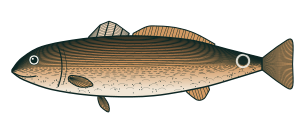
Right now: 98 for striped bass, goTap or drag along the water to move through the next 36 hours
Striped bass, hour by hour
Each float is an hour. The deeper it rides, the better the bite. The strip underneath runs daylight, dusk and dark; the red rule marks the best window. Click any hour to read it.
983 am
98
98
986 am
98
92
889 am
88
88
9212 pm
92
100
983 pm
98
98
946 pm
88
88
889 pm
88
88
88Tue
94
100
983 am
98
98
986 am
98
83
879 am
83
83
8312 pm
87
92
Go, 85+Worth the trip, 70+Marginal, 55+Sit it out
Right now
Water
63°F
Striped bass range 50–72°
Wind
10 mph
From the northeast
Light
Dark
Sunrise 7:20 am
Sky
Clear
No rain expected
Air
55°F
NWS hourly forecast
Barometer
Falling
Measured, last 3 hours
Moon
100% lit
Full
What’s biting
Each species is scored against its own water-temperature range and tide preference, then wind, weather and warnings. The rules are Virginia tidal (VMRC) regulations for these waters.
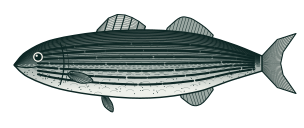
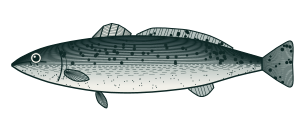
Right in striped bass's ideal range. Striped bass prefers incoming tide. Fish feed actively ahead of a pressure drop. Holds 5–35 ft down.
Keep
28" minimum · 31" maximum · 1 a day
Open. Keep fish within the limits. Virginia coastal waters (the ocean out to 3 miles and the seaside of the Eastern Shore and Virginia Beach): 1 fish a day, 28–31", open Jan 1–Mar 31 and May 16–Dec 31. Federal waters beyond 3 miles are closed. Non-offset circle hooks with bait; no gaffing.
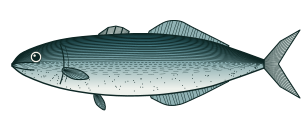
Spotted seatrout prefers incoming tide. Fish feed actively ahead of a pressure drop. Light chop — baitfish active, fish willing to feed. Holds 3–15 ft down.
Keep
14" minimum · 5 a day
Open. Keep fish within the limits. Virginia tidal waters: 14" minimum, 5 a day with no more than 1 over 24". Recreational anglers may not take, catch or possess speckled trout from Apr 1 to Jun 30, 2026 (4VAC20-280-30).
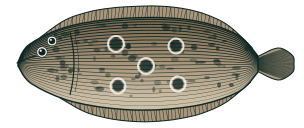
Right in summer flounder's ideal range. Fish feed actively ahead of a pressure drop. Light chop — baitfish active, fish willing to feed. Holds 10–100 ft down.
Keep
16" minimum · 4 a day
Open. Keep fish within the limits. Virginia tidal waters: 16" minimum Jan 1–May 31 and 17.5" Jun 1–Dec 31, 4 a day, open all year. Federal waters follow NOAA Fisheries rules.
Solunar tables are a popular heuristic. A peer-reviewed test found they don’t predict catch on their own, so here they only nudge the score when the tide or moon already agree. How the score works
Fishing report
No current report covers these waters.
We only show reports an agency has published, with their date. Virginia DWR has the state’s fishing pages.
Undeveloped barrier beach between Back Bay and the ocean, reached on foot, by bike or by boat. Red drum in spring and fall, striped bass in winter, bluefish, summer flounder and speckled trout through the warm months.
Public spots within 40 miles, with the same 36 hours of floats.
3 am
6 am
9 am
12 pm
3 pm
6 pm
9 pm
Tue
3 am
6 am
9 am
12 pm
Sandbridge Beach10 mi · VirginiaBest tonight 2 am–8 am
100Go
Rudee Inlet — Virginia Beach15 mi · VirginiaBest tonight 1 am–8 amSmall Craft Advisory
77Worth the trip
First Landing State Park23 mi · VirginiaBest tonight 12 am–8 am
90Go
Ocean View Beach30 mi · VirginiaBest tonight 1 am–8 am
90Go
Buckroe Beach37 mi · VirginiaBest tonight 12 am–8 am
90Go
Anderson Park37 mi · VirginiaBest now until tomorrow 8 am
100Go
Questions people ask
Do I need a fishing license to fish at False Cape State Park?
Yes (anglers age 16 and older). To fish at False Cape State Park you need a Virginia saltwater recreational fishing license issued by VMRC, or a free Virginia Fisherman Identification Program (FIP) registration if otherwise exempt. See the agency's current rules: https://mrc.virginia.gov/regulations/recfish-licensing.shtm
What fish are commonly targeted at False Cape State Park?
False Cape State Park is listed on this site for 5 commonly-targeted species: Red Drum, Striped Bass, Bluefish, Summer Flounder, and 1 more. Which species is currently in season and which is scoring highest today is shown in the per-species ranking on this page.
When is the best time to fish at False Cape State Park?
It depends more on the species and the day's conditions than on a fixed "best hour." Water temperature, weather, and — at tidal locations — the stage of the tide drive activity most. The per-species ranking on this page scores every target species at False Cape State Park against today's live conditions, so the fish near the top are your best bets right now; check back as conditions change through the day.
What kind of access does False Cape State Park have?
False Cape State Park has multiple access types — pier, shoreline, and at least one public boat ramp.
Which state's fishing regulations apply at False Cape State Park?
Virginia Marine Resources Commission (VMRC) saltwater regulations apply at False Cape State Park. Size limits, creel limits, and seasonal closures are listed per species on each species page. Always confirm against the agency source linked from each regulation block — emergency closures can take effect mid-season.
Is False Cape State Park tidal water?
Yes. False Cape State Park sits on tidal water with a NOAA tide station nearby. Today's high/low timing is in the tide chart on this page.
Press / anywhere to search. Towns list the closest spots.