Jennings Randolph Lake

Garrett County, MD

A US Army Corps of Engineers reservoir straddling the MD–WV border in Garrett County. Approximately 952 acres with public boat ramps and shoreline access. Good walleye and largemouth fishery.

Live · updated

Walleye — Marginal conditions for Walleye.

Best conditions of 5 species tracked at Jennings Randolph Lake.

47 /100
ok
Air Temp
87°F
Mostly Sunny then Showers And Thunderstorms
Wind
8 to 13 mph
W
Rain
88%
Friday
Pressure
Steady
6-hour trend
Water Temp
56°F
Inland
Flow
72.9 cfs
Steady · +0% / 24h
Sunrise
5:49 AM
Sunset
8:43 PM
Moon · 11%
waning crescent

5 species tracked, ranked by today's conditions. The top pick is open below — tap any species to expand it, or a chip to focus.

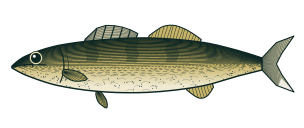
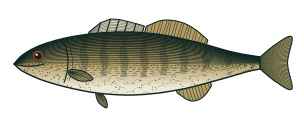
#1 Walleye Marginal conditions for Walleye. In season 47/100

What's helping

  • 56°F water — inside walleye's active range
  • Dark moon — walleye feeds aggressively in low light
  • 13 mph wind — light chop — baitfish active, fish willing to feed
  • Stable flow — settled river level — clearer water, easier wading

What's hurting

  • Thunderstorms — get off the water immediately when storms approach

About. Sander vitreus — Maryland's premier cool-water gamefish. Deep Creek Lake is the flagship fishery; also found in the non-tidal Potomac and the Youghiogheny River. Low-light feeder — dusk, dawn, and overcast/windy days are prime. Jigs, crankbaits, and nightcrawler harnesses are standard.

Prefers. Water 50–72°F (ideal 62°F) · either tide · depth 10–40 ft.

Regulations may be out of date

Last verified 51 days ago on 2026-04-22. Open source page →

Min size
15"
Daily creel
5

Statewide: 15-inch minimum, 5 per day. Deep Creek Lake has an 18–21 inch protected slot (all fish in slot must be released) AND is closed March 1–April 15. Potomac River has a 20-inch protected-slot provision Jan 1–Apr 15 in some sections. Verify water-specific regulations before keeping any fish.

Source: Maryland non-tidal regulations · verified 2026-04-22.

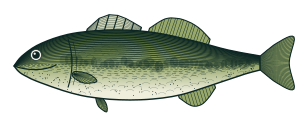
#2 Smallmouth Bass Marginal conditions for Smallmouth Bass. In season 35/100

What's helping

  • 56°F water — inside smallmouth bass's active range
  • 13 mph wind — light chop — baitfish active, fish willing to feed
  • Stable flow — settled river level — clearer water, easier wading

What's hurting

  • Thunderstorms — get off the water immediately when storms approach

About. Micropterus dolomieu — Premier gamefish of the non-tidal Potomac, the Upper Susquehanna, and Deep Creek Lake. Pound-for-pound one of the hardest-fighting freshwater fish. Hits tubes, crayfish imitations, spinnerbaits, and topwater poppers.

Prefers. Water 55–78°F (ideal 68°F) · either tide · depth 3–30 ft.

Regulations may be out of date

Last verified 51 days ago on 2026-04-22. Open source page →

Min size
12"
Daily creel
5

Non-tidal MD: 12-inch minimum, 5 per day in aggregate with largemouth bass. Harvest season is June 16 through the last day of February. March 1–June 15 is catch-and-release only. Special regulations apply on sections of the non-tidal Potomac — check site-specific rules.

Source: Maryland non-tidal regulations · verified 2026-04-22.

#3 Largemouth Bass Skip the Largemouth Bass trip today. In season 29/100

What's helping

  • 56°F water — inside largemouth bass's active range
  • 13 mph wind — light chop — baitfish active, fish willing to feed

What's hurting

  • Thunderstorms — get off the water immediately when storms approach

About. Micropterus salmoides — Most popular gamefish in MD non-tidal waters. Ambush predator around cover — lily pads, submerged timber, docks, grass edges. Hits plastics, spinnerbaits, jigs, and topwater across the season.

Prefers. Water 55–85°F (ideal 72°F) · either tide · depth 3–25 ft.

Regulations may be out of date

Last verified 51 days ago on 2026-04-22. Open source page →

Min size
12"
Daily creel
5

Non-tidal MD: 12-inch minimum, 5 per day in aggregate with smallmouth bass. Harvest season is June 16 through the last day of February. March 1–June 15 is catch-and-release only to protect the spawn. Some waters have special regulations (slot limits, lower creel) — check the water-specific page.

Source: Maryland non-tidal regulations · verified 2026-04-22.

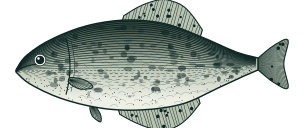
#3 Crappie Skip the Crappie trip today. In season 29/100

What's helping

  • 56°F water — inside crappie's active range
  • 13 mph wind — light chop — baitfish active, fish willing to feed

What's hurting

  • Thunderstorms — get off the water immediately when storms approach

About. Pomoxis spp. — Covers both black crappie (P. nigromaculatus) and white crappie (P. annularis). Schooling panfish around brush, docks, and submerged timber. Spring pre-spawn is the prime season — small minnows and 1/16-oz jigs are the go-to.

Prefers. Water 50–80°F (ideal 65°F) · either tide · depth 3–20 ft.

Regulations may be out of date

Last verified 51 days ago on 2026-04-22. Open source page →

Daily creel
15

Non-tidal MD: no minimum size, 15 per day in aggregate (black + white crappie). Open year-round.

Source: Maryland non-tidal regulations · verified 2026-04-22.

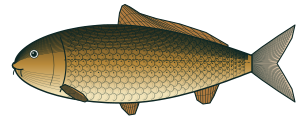
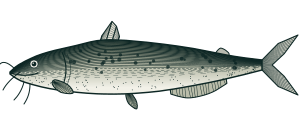
#5 Channel Catfish Skip the Channel Catfish trip today. In season 0/100

What's helping

  • 13 mph wind — light chop — baitfish active, fish willing to feed

What's hurting

  • 56°F water — below channel catfish's active range (60–85°f)
  • Thunderstorms — get off the water immediately when storms approach

About. Ictalurus punctatus — Native catfish of MD non-tidal rivers, reservoirs, and farm ponds. Bottom-feeder that takes chicken liver, stinkbait, nightcrawlers, and cut bait. Most active at night and in warm water.

Prefers. Water 60–85°F (ideal 75°F) · either tide · depth 5–30 ft.

Regulations may be out of date

Last verified 51 days ago on 2026-04-22. Open source page →

Daily creel
5

Non-tidal MD: no minimum size, 5 per day, open year-round. Standard freshwater fishing license required.

Source: Maryland non-tidal regulations · verified 2026-04-22.

Water Body

Reservoir

Access

Pier, shore, and ramp

Jurisdiction

Maryland non-tidal

Coordinates

39.4193, -79.1268

Notes

Managed jointly by MD DNR and WV WVDNR; check both states' regs. Free access. Campground on-site.

What anglers are reporting

From the Maryland DNR weekly fishing report, published May 27, 2026 · 15 days old — a newer report may be available.

Freshwater Fishing

Maryland’s spring trout stocking season is now complete. Stocking began in February and wrapped up on May 18. A total of 254,810 trout were stocked; 182,260 trout were stocked into open waters and 72,550 stocked under the closure period. Trout were stocked into 118 waterbodies, including 53 streams and rivers and 65 lakes and ponds. The next period of regular trout stocking will begin in October. Due to warming water temperatures, some delayed harvest trout management waters (known as Group I) in the central and parts of the western region will open to trout harvest from June 1 to September 30.

Species mentioned: trout

Excerpts are anecdotal and reflect a single week's observations from DNR biologists and reporting anglers — not predictions. Use as one signal among many; verify against current conditions before planning a trip.

Local reports & rules for Jennings Randolph Lake: Maryland DNR fishing report → · trout stocking schedule → · fish-consumption advisory →

Do I need a fishing license to fish at Jennings Randolph Lake?

Yes (anglers age 16 and older). To fish at Jennings Randolph Lake you need a Maryland non-tidal fishing license issued by MD DNR (and a separate Maryland trout stamp if targeting trout in non-tidal waters). See the agency's current rules: https://dnr.maryland.gov/pages/service_fishing_license.aspx

What fish are commonly targeted at Jennings Randolph Lake?

Jennings Randolph Lake is listed on this site for 5 commonly-targeted species: Largemouth Bass, Smallmouth Bass, Walleye, Crappie, and 1 more. Which species is currently in season and which is scoring highest today is shown in the per-species ranking on this page.

When is the best time to fish at Jennings Randolph Lake?

It depends more on the species and the day's conditions than on a fixed "best hour." Water temperature, weather, and — at tidal locations — the stage of the tide drive activity most. The per-species ranking on this page scores every target species at Jennings Randolph Lake against today's live conditions, so the fish near the top are your best bets right now; check back as conditions change through the day.

What kind of access does Jennings Randolph Lake have?

Jennings Randolph Lake has multiple access types — pier, shoreline, and at least one public boat ramp. Managed jointly by MD DNR and WV WVDNR; check both states' regs. Free access. Campground on-site.

Which state's fishing regulations apply at Jennings Randolph Lake?

Maryland DNR non-tidal (inland) regulations apply at Jennings Randolph Lake. Size limits, creel limits, and seasonal closures are listed per species on each species page. Always confirm against the agency source linked from each regulation block — emergency closures can take effect mid-season.

Is Jennings Randolph Lake tidal water?

No. Jennings Randolph Lake is non-tidal — water level varies with rainfall, seasonal flow, and (where applicable) upstream dam releases rather than tidal exchange.

esc