King County, WA · Pacific Ocean
Puget Sound (Seattle)
The inland sea of western Washington — a marine fishery for chinook ("blackmouth") and coho salmon trolled and mooched by marine area, plus lingcod and rockfish on the rocky structure. Fished from boats and public piers around Seattle and the Sound. Live tide and water temperature from the Seattle station.
Live · updated
Top picks today
Chinook Salmon, Coho Salmon, Lingcod & Rockfish — tied at the top (23/100)
4 species tied for best of 4 tracked at Puget Sound (Seattle).
Atmosphere
Water
Sun & Moon
Today's Tides
| Time | Type | Height |
|---|---|---|
| 3:41 AM | Low | 7.2 ft |
| 7:47 AM | High | 8.4 ft |
| 2:49 PM | Low | -0.6 ft |
| 10:22 PM | High | 11.4 ft |
Species at Puget Sound (Seattle)
4 species tracked, ranked by today's conditions. The top 4 (tied) are open below — tap any species to expand it, or a chip to focus.
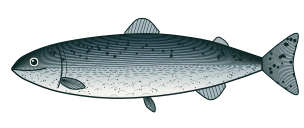
#1 Chinook Salmon Skip the Chinook Salmon trip today. In season 23/100
What's helping
- 14 mph wind — light chop — baitfish active, fish willing to feed
What's hurting
- Thunderstorms — get off the water immediately when storms approach
About. Oncorhynchus tshawytscha — The “king” — the largest Pacific salmon and the marquee stocked predator of the Great Lakes. Trolled over open water through summer, then staged off river mouths and run up tributaries on the fall spawning push. Flow and water temperature drive the river bite.
Prefers. Water 42–58°F (ideal 50°F) · either tide · depth 15–150 ft.
- Daily creel
- 2
Washington marine (Puget Sound): chinook seasons and limits are set by marine area and change in-season — commonly 1–2 with adults capped, mark-selective. Confirm the area before fishing.
Source: Washington regulations · verified 2026-06-03.
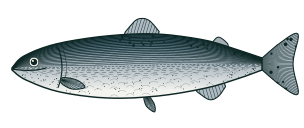
#1 Coho Salmon Skip the Coho Salmon trip today. In season 23/100
What's helping
- 14 mph wind — light chop — baitfish active, fish willing to feed
What's hurting
- Thunderstorms — get off the water immediately when storms approach
About. Oncorhynchus kisutch — “Silvers” — acrobatic, aggressive salmon that school near the surface and along piers in summer before their fall tributary run. A staple of the Great Lakes stocking program and the Pacific coast alike.
Prefers. Water 44–58°F (ideal 53°F) · either tide · depth 10–120 ft.
- Daily creel
- 2
Washington marine (Puget Sound): coho limits reduced in recent years (often 1/day, mark-selective) and area-specific. Confirm the marine area.
Source: Washington regulations · verified 2026-06-03.
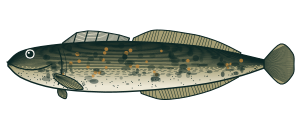
#1 Lingcod Skip the Lingcod trip today. In season 23/100
What's helping
- 14 mph wind — light chop — baitfish active, fish willing to feed
What's hurting
- Thunderstorms — get off the water immediately when storms approach
About. Ophiodon elongatus — A toothy, aggressive ambush predator of Pacific rocky reefs and kelp — hammers jigs and live bait fished near the bottom. Often caught while rockfishing; big “lings” are a prize from jetties and nearshore reefs.
Prefers. Water 45–58°F (ideal 52°F) · either tide · depth 20–300 ft.
- Daily creel
- 2
No minimum size, 2/day. Coastal season mid-Mar–mid-Oct.
Source: Washington regulations · verified 2026-05-29.
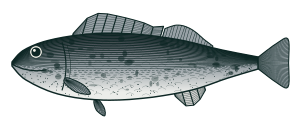
#1 Rockfish Skip the Rockfish trip today. In season 23/100
What's helping
- 14 mph wind — light chop — baitfish active, fish willing to feed
What's hurting
- Thunderstorms — get off the water immediately when storms approach
About. Sebastes spp. — The Pacific “RCG complex” — dozens of Sebastes species worked over rocky reefs, kelp, and structure from jetties to offshore banks. The backbone of West Coast bottom fishing; dropped baits and shrimp flies take them.
Prefers. Water 45–58°F (ideal 52°F) · either tide · depth 20–300 ft.
- Daily creel
- 7
7 rockfish within a 9-fish bottomfish aggregate. Copper, quillback, and vermilion rockfish are closed May–July. Coastal season mid-Mar–mid-Oct.
Source: Washington regulations · verified 2026-05-29.
Location Info
Water Body
Pacific Ocean
Access
Pier, shore, and ramp
Jurisdiction
Washington
Coordinates
Notes
WA: Puget Sound salmon seasons and limits are set by marine area and change in-season (coho often 1/day, mark-selective). Confirm the marine area before fishing.
Local reports & rules for Puget Sound (Seattle): Washington WDFW fishing report → · trout stocking schedule → · fish-consumption advisory →
Nearby Access Points
Frequently Asked
Do I need a fishing license to fish at Puget Sound (Seattle)?
Yes (anglers age 16 and older). To fish at Puget Sound (Seattle) you need the appropriate state fishing license. See the agency's current rules: the state agency website
What fish are commonly targeted at Puget Sound (Seattle)?
Puget Sound (Seattle) is listed on this site for 4 commonly-targeted species: Chinook Salmon, Coho Salmon, Lingcod, Rockfish. Which species is currently in season and which is scoring highest today is shown in the per-species ranking on this page.
When is the best time to fish at Puget Sound (Seattle)?
It depends more on the species and the day's conditions than on a fixed "best hour." Water temperature, weather, and — at tidal locations — the stage of the tide drive activity most. The per-species ranking on this page scores every target species at Puget Sound (Seattle) against today's live conditions, so the fish near the top are your best bets right now; check back as conditions change through the day.
What kind of access does Puget Sound (Seattle) have?
Puget Sound (Seattle) has multiple access types — pier, shoreline, and at least one public boat ramp. WA: Puget Sound salmon seasons and limits are set by marine area and change in-season (coho often 1/day, mark-selective). Confirm the marine area before fishing.
Which state's fishing regulations apply at Puget Sound (Seattle)?
state agency regulations apply at Puget Sound (Seattle). Size limits, creel limits, and seasonal closures are listed per species on each species page. Always confirm against the agency source linked from each regulation block — emergency closures can take effect mid-season.
Is Puget Sound (Seattle) tidal water?
Yes. Puget Sound (Seattle) sits on tidal water with a NOAA tide station nearby. Today's high/low timing is in the tide chart on this page.